Some of Pennsylvania’s best views are found on the water. Explore thousands of miles of waterways with a paddling adventure!
Before you launch, make sure you and your crew are familiar with the proper paddling techniques and safety tips so your adventure on the water is fun AND safe!
Required Equipment
Of course, you will need your boat and paddle. Select a boat that is recommended for the type of activity, the type of water and the water conditions you are planning to paddle. And, remember, conditions can change quickly and can become unsafe for your paddling activity.
Life Jackets. The most important piece of equipment you will need when paddling. Life jackets are required for all passengers and must be worn for paddlers 12 years old and under. Wearing it can save your life. Make it a healthy habit and always wear it, just like fastening your seatbelt in a car.
Night Lights. If you plan to paddle between the hours of sunset and sunrise, a white light must be readily available for use. Lights are also important in times of low visibility, such as fog or heavy rain. These navigation lights are designed to identify the type of boat on the water.
Boat Registration or Launch Permit. Paddlers accessing Pennsylvania Fish and Boat Commission, PA State Park or PA State Forest launches must display a boat registration or launch permit on their boat. Discover which is best for you in our “What to Know About Pennsylvania Launch Permits and Boat Registrations” blog.
Whistle (or sound-producing device). Paddlers are required to have a whistle or sound-producing device that can be heard by another boater in time to avoid a collision. Whistles can easily be attached to a life jacket for quick use.
Learn other basic tips in our “Know Before You Go Paddling” blog.
1. Proper Paddle Use
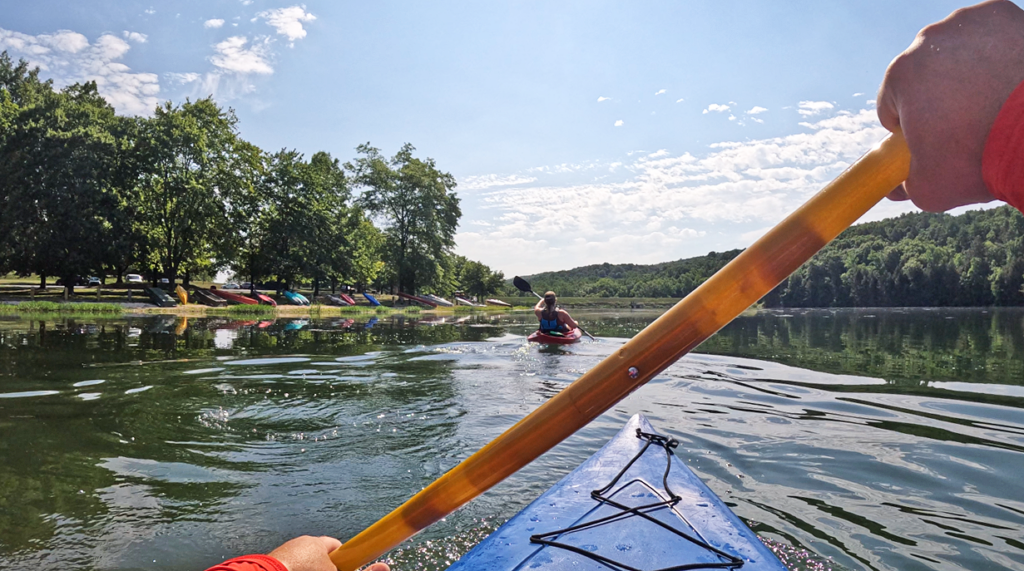
For proper paddle use, your arms should hold the paddle shoulder-width apart with your knuckles facing up.
The curve of the paddle should face you. Most paddles have a logo or design on the curve. If this is the case for your paddle, the logo/design should face you.
2. Forward Stroke
Use the Forward Stroke to move you and your boat forward on the water.
Reach your paddle blade into the water toward the front of the boat and pull back in the water toward the back of the boat. Then lift your paddle out of the water, and repeat on each side to continue moving forward.
3. Reverse Stroke
Use the Reverse Stroke to slow down or move your boat backwards on the water.
Reach your paddle blade into the water toward the back of the boat and push the blade forward in the water toward the front of the boat. Then lift your paddle out of the water, and repeat on each side to continue moving in reverse.
4. Sweep Stroke
Use the Sweep Stroke to turn your boat left or right.
Reach your paddle blade toward the front of your boat and pull the blade in a wide “C” sweep toward the back of your boat.
To turn right, sweep on the left side of your boat.
To turn left, sweep on the right side of your boat.
5. Draw Stroke
Use the Draw Stroke to draw toward or away from a dock, boat launch, or shoreline.
Reach your paddle out on the side facing where you want to go, whether that is drawing near something or moving away from it. Then, pull the paddle to the boat.
If you are drawing toward a dock or boat launch, reach your paddle out on the side of the launch and pull the paddle toward the boat.
If you are drawing away from a dock, boat launch or are trying to avoid a hazard, reach your paddle out on the opposite side and pull the paddle toward the boat.
Paddling Safety and Best Practices
The most important thing you can do when you are out paddling is to wear your life jacket and have the required equipment for a safe day on the water.
Here are some other tips and recommendations to know before you head out:
- Keep 3 points of contact and stay low when getting into or onto your boat.
- Check the weather forecast before you go, and keep a watch for sudden changes. Make your way to shore and seek shelter before hazardous weather occurs.
- Scout ahead whenever possible. Know the river/waterbody.
- Be prepared to swim. If the water looks too hazardous to swim in, don’t go paddling. Always know the water’s conditions before launching.
- If you fall out in a fast moving water keep your feet up on the surface of the water and swim to shore.
- If you capsize, hold on to your boat, unless it presents a life-threatening situation.
- Wear wading shoes or tennis shoes to protect your feet.
- Never take your boat over a low-head dam. Carry (portage) your boat around water you are not sure about.
- Never boat alone.
With these tips and recommendations, you are well equipped to enjoy a day exploring Pennsylvania’s scenic waterways.
Always remember to wear your life jacket. Have fun and be safe!